Short answer
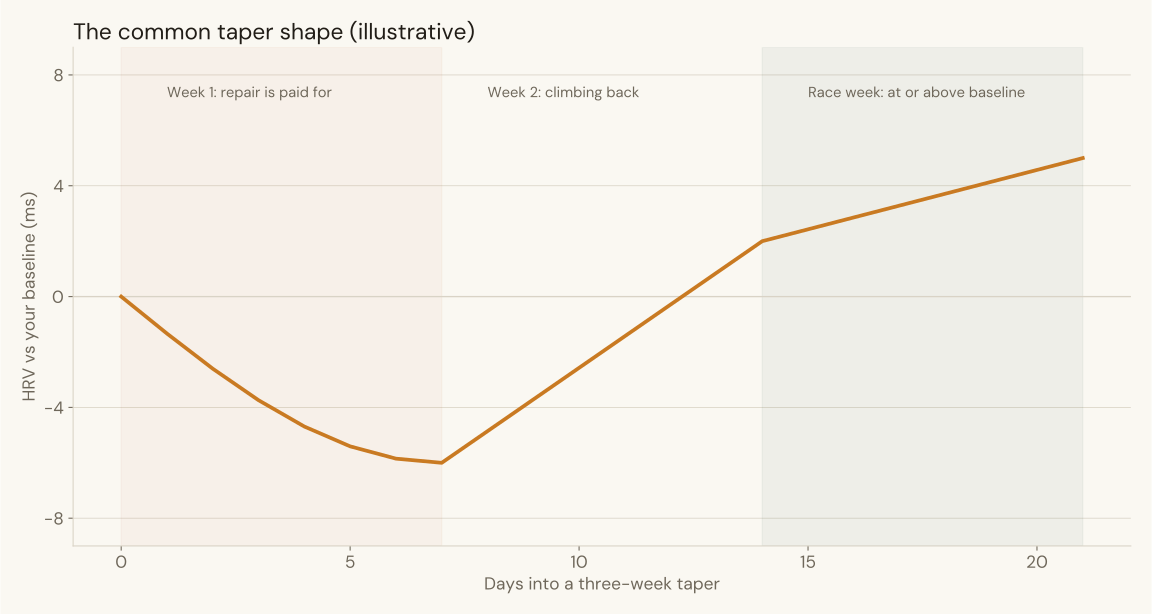
A falling HRV in the first taper week is usually normal. Heavy training defers repair, and cutting volume is when the body finally does it — muscle repair, glycogen restoration and plasma volume shifts are all metabolically demanding, so the metrics dip while you train least. The pattern typically recovers toward baseline in the second week. It is a genuine flag only if the trend keeps falling into race week, if resting heart rate rises with no session to explain it, or if a niggle has a specific location and mechanism.
Twelve weeks of work, done. Volume comes down. You are running less than you have in months, sleeping in your own bed, eating properly.
And your HRV falls. Resting heart rate creeps up. Your legs feel like someone swapped them out. A four-minute easy run pace feels like tempo, and a phantom niggle appears in a calf that has been fine since April.
The instinct is to read this as a problem — that the taper is not working, or that you have lost fitness, or that you are getting sick. Usually it is none of those. It is what the recovery process looks like from the inside, and the last place most runners expect to find it is in a week where they are doing less.
Why less training can suppress HRV
The intuition that rest raises HRV assumes the cost of a training block is paid at the time. It is not. Heavy load runs up a debt — muscle damage, glycogen depletion, inflammation, autonomic strain — and much of the repair only happens once you stop adding to it.
So the first days of a taper are not the body relaxing. They are the body finally getting to do the expensive work it has been deferring. Repair is metabolically demanding, and it registers exactly as you would expect a demanding process to register.
There is a second mechanism worth knowing. Cardiac parasympathetic reactivation after exercise tracks closely with plasma volume changes — and the volume shifts that follow a heavy block take days, not hours, to settle. Some of what you see in the first taper week is fluid, not fatigue.
The taper is not when recovery starts paying out. It is when recovery starts being paid for.
What the research actually found
A study published in Frontiers in Physiology tracked 11 male runners through a full cycle: one week of light training, two weeks of heavy training, then a 10-day taper — measuring 5km time-trial performance, post-exercise HRV and subjective training tolerance at each stage.
The heavy block did what heavy blocks do: 5km time slowed, and subjective training tolerance dropped sharply. Then the taper reversed both — time-trial performance almost certainly improved, and subjective tolerance improved with it.
The useful part is the sequencing. Performance was worst at the end of the heavy block, when the athletes had built the most fitness. It improved during the phase where they trained least. That is the fitness-fatigue model running in front of you: performance equals fitness minus fatigue, and the taper works by shedding fatigue, not by adding anything.
Which is also why the mid-taper dip is not evidence of anything going wrong. Fatigue decays faster than fitness, but it does not decay instantly, and the first days of shedding it are the days you feel it most.
What the taper curve usually looks like
Individual variation here is large, so treat this as a shape rather than a schedule. But across a standard two-to-three week marathon taper, the common pattern:
| Phase | What you often see | Read |
|---|---|---|
| First taper week | HRV flat or falling, RHR steady or slightly up, legs heavy, phantom niggles | Expected. Repair is underway. |
| Second week | HRV climbing back toward baseline, RHR settling, pace starting to feel normal again | The taper is working. |
| Race week | HRV at or above baseline, RHR at or below, sessions feel easy | Sharpening as intended. |
| Carb load days | Scale weight up 1–2kg, HRV may move either way | Glycogen and water. Not fat, not fitness. |
The carb-loading row catches people out most. Each gram of stored glycogen brings water with it, so the weight gain in the final days is the loading working, not a nutrition error — the arithmetic is in the carb loading guide. Do not try to optimise HRV during a carb load. You are optimising for the race, not for a number.
When the dip is actually a flag
None of the above means every taper reading is benign. Three patterns are worth taking seriously.
It keeps falling into race week
A first-week dip that recovers is normal. A trend still heading down five or six days out is not the taper — it usually means the taper started too late or is too shallow for the load you built. Cut volume further rather than trying to train through it.
HRV down and resting heart rate up, with no session to explain it
In taper you are not generating much load, so a suppression without a cause is more informative than usual. This is the early illness pattern, and race week is a well-documented window for picking something up.
The niggle has a location and a mechanism
Taper phantom pains wander, change day to day, and have no clear onset. A pain in one spot that reproduces on a specific movement is not a taper tantrum. Treat it as an injury and get it looked at.
Ordinary post-block fatigue is also worth distinguishing from something deeper: if the flatness has been building for weeks rather than days, the question is whether you were overreaching before the taper began.
What to do with a bad taper reading
The single most damaging response is to test yourself. A hard session to check the fitness is still there does not answer the question — you cannot outrun taper fatigue in a week — and it re-adds exactly the load you are trying to shed.
What works better:
Keep intensity, cut volume. The evidence on tapering favours preserving some race-pace work while dropping overall load substantially. A few short reps at goal pace maintains the neuromuscular pattern without generating meaningful fatigue.
Judge the trend, not the morning. A single low reading in taper week means very little. The direction across three or four days means considerably more.
Sleep like it is a session. It is the highest-leverage thing available, and the taper finally gives you time for it — see how much runners actually need.
Expect race morning to feel unremarkable. Plenty of good races start with legs that feel merely fine. The adrenaline arrives on the start line, not on Thursday.
And keep the conditions in view. If race morning turns out hot and humid, your goal pace was written for weather you may not get — the dew point tax is real, and it is a better reason to adjust your target than anything your HRV did on Wednesday.
Kovr reads the taper as a taper, not as a decline.
A falling HRV means something different in week two of a build than it does five days out from a race. Kovr weighs the reading against the block you just finished, the load you have shed, the conditions and what you have eaten — so a normal taper dip reads as a normal taper dip, and a suppression with nothing behind it gets flagged as something else. Race week, it moves your fuel targets with the plan rather than leaving the timing to you.
Download Kovr on the App StoreFree with a 14-day trial · Garmin, Apple Watch & Oura
Sources cited
- Stanley, J., Halliday, A. et al. (2020). The Impact of Functional Overreaching on Post-exercise Parasympathetic Reactivation in Runners. Frontiers in Physiology, 11, 614765 — 11 runners across light training, two weeks of heavy training, and a 10-day taper.
- Buchheit, M. (2013). Cardiac Parasympathetic Reactivation Following Exercise: Implications for Training Prescription. Sports Medicine — on the relationship between parasympathetic reactivation and plasma volume.
- Plews, D.J., Laursen, P.B., Stanley, J., Kilding, A.E. & Buchheit, M. (2013). Training adaptation and heart rate variability in elite endurance athletes: opening the door to effective monitoring. Sports Medicine — on RMSSD as the preferred index for monitoring training status.
- Banister, E.W. (1991). Modeling elite athletic performance. In: Physiological Testing of Elite Athletes — the fitness-fatigue model.
Frequently asked questions
Is it normal for HRV to drop during taper?
Yes, particularly in the first taper week. Heavy training defers repair, and reducing volume is when the body finally carries it out — muscle repair, glycogen restoration and plasma volume shifts are all metabolically demanding. The pattern typically recovers toward baseline during the second week.
Why do I feel terrible during taper when I'm running less?
Because the taper is when recovery gets paid for, not when it pays out. Heavy legs, sluggishness and phantom niggles are the repair process being felt from the inside. In one study of 11 runners, 5km performance was at its worst at the end of the heavy block and improved through the taper — fitness was already built, fatigue was still masking it.
When is a taper HRV drop actually a problem?
Three cases. If the trend is still falling five or six days out, the taper likely started too late or is too shallow. If HRV is down and resting heart rate is up with no session to explain it, treat it as a possible early illness signal. And if a niggle has a specific location and reproduces on a specific movement, it is an injury, not a taper phantom.
Should I do a hard session to check my fitness during taper?
No. It cannot answer the question — you cannot outrun taper fatigue in a week — and it re-adds the exact load you are trying to shed. Keep some short race-pace work to hold the neuromuscular pattern, but cut overall volume substantially.
Why did my weight go up during race week?
Glycogen and water. Every gram of stored glycogen brings water with it, so 1–2kg of gain across the final loading days is the carb load working rather than a nutrition error. Do not try to optimise HRV during a carb load.
How long does the taper dip last?
Most commonly the first week, with metrics climbing back toward baseline through the second week and sitting at or above baseline by race week. Individual variation is large, so the shape matters more than the schedule — what you are looking for is direction across several days, not any single morning.