Short answer
Read heart rate against pace rather than pace alone. If the run was slower but heart rate at that pace was normal, or elevated on a hot day, conditions are the cause — heat and humidity add cardiovascular load without touching fitness. Genuine fitness loss shows as elevated heart rate at a given pace in cool conditions, sustained across weeks rather than days.
The number on your watch is slower than it was a week ago. Same route, same easy effort, and yet the pace has drifted the wrong way. The thought arrives before you can stop it: I’m losing fitness.
It’s one of the most common worries in endurance training, and one of the most often wrong. A single slower run — or even a slower week — is rarely the body declining. Far more often it’s the weather quietly taxing the same engine. The problem is that a stopwatch can’t tell the two apart. The pace looks identical whether you’ve detrained or just run through humid air. You need to look at something else.
Why the weather slows you down without touching your fitness
When you run in heat and humidity, your body faces a competing demand. It needs to send oxygen-rich blood to your working muscles, but it also needs to send blood to your skin to shed heat. There’s only so much to go around. As more blood is diverted to cooling, your heart beats faster to keep the muscles supplied — so your heart rate climbs at a pace that felt comfortable in cooler conditions.
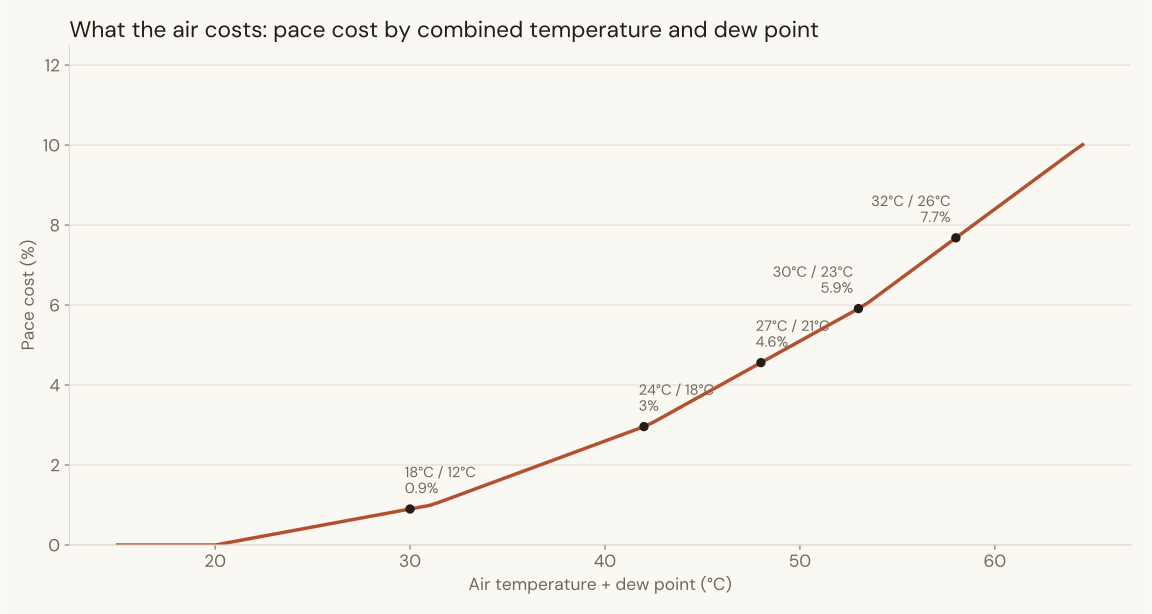
Humidity makes it worse. Sweating only cools you when the sweat evaporates, and in moist air it can’t. That’s why dew point matters more than temperature — it measures how saturated the air already is, and therefore how much of your cooling system is actually working. Above a dew point of about 15°C, the cost starts to bite; above 18°C it’s significant.
None of this is fitness loss. It’s a tax. The same run costs more because the environment added load on top of the effort. One coach put the reframe bluntly to an athlete who’d moved from cool California to humid Long Island: the same easy run that sat at 150 beats per minute back home now sat at 162 in the heat — same legs, same effort, twelve extra beats bought entirely by the weather.
“You didn’t lose fitness overnight. You’re fighting physics. The pace is slower because the air made it slower — not because the engine shrank.”
The tell: read heart rate against pace, not pace alone
Here is the single most useful distinction, and it’s simpler than most people expect.
If you ran slower but your heart rate was higher than normal, the weather did it. Your body was working hard — harder than the pace suggests — because it was cooling itself at the same time. The fitness is intact; it was just spending some of its output on temperature control. This is the signature of a hot, humid, or poorly-recovered day.
If you ran slower and your heart rate was normal or lower, that’s the pattern that actually points toward lost fitness. The engine produced less at the same internal cost. And even then, one such run isn’t proof — you need to see it hold across cool days too, not just warm ones.
| What you saw | Most likely cause | Fitness verdict |
|---|---|---|
| Slower pace, higher HR, warm/humid day | Heat & humidity | Intact |
| Slower pace, higher HR, cool day after a hard block | Fatigue / load | Intact, under-recovered |
| Slower pace, normal or lower HR, across several cool days | Possible detraining | Worth investigating |
| Slower pace, normal HR, after 1–3 weeks off | Genuine fitness loss | Real, but recoverable |
This is why runners who train only to pace get rattled every summer, and runners who watch heart rate stay calm. The pace lies in the heat. The heart rate tells the truth.
The mechanism inside a single run has its own name — cardiac drift — and the same conditions quietly invalidate your watch’s goal time, which is why race predictors disagree with each other and with race day.
What your morning numbers add
There’s a second layer that confirms the story, and it shows up before you even lace up: your overnight recovery markers.
Heat is a genuine physiological stressor, not just an in-the-moment discomfort. A slow, easy run in extreme heat can suppress your next-morning HRV about as much as a hard interval session would — because your body spent the run managing core temperature, and that costs something to recover from. So during a hot spell, a lower HRV and a slightly elevated resting heart rate are often normal and temporary. They reflect the environment loading you, not your fitness draining away.
That distinction is everything. If HRV dips for a few days during a heatwave and climbs back as soon as conditions ease, the weather was the cause. If it stays suppressed for a week or more with no heat to explain it, that’s a different signal — accumulating fatigue, under-recovery, or the early edge of overreaching — and worth acting on.
The rule that keeps you sane
Watch trends, not single days. HRV is noisy and one low morning means little. Compare like with like — the same route, similar conditions — and judge fitness over weeks, not from one slow Tuesday. The body rarely loses fitness in a day; it loses it over one to three weeks of greatly reduced training.
How to actually run the check
Next time a run comes in slow and the doubt starts, work through this before blaming your fitness:
- Was it warm or humid? Check the dew point at run time, not just the temperature (our free heat-adjusted pace calculator does the maths). Above 15°C, expect the pace to cost more.
- Was your heart rate higher than usual for that pace? If yes, the weather explains the slowdown almost on its own.
- How was this morning’s HRV and resting HR? Suppressed during a hot spell is normal. Suppressed for over a week with no heat is the real flag.
- Does the slowness persist on cool days? If you only run slow when it’s hot and bounce back when it’s cool, your fitness is fine.
- Have you actually had time off? Real detraining takes one to three weeks of greatly reduced training. A consistent week of normal training doesn’t erase fitness.
In the overwhelming majority of cases, the answer lands on weather or fatigue — not fitness loss. And the practical move on a hot day is the same either way: run by effort or heart rate, not pace. Holding your normal pace through heat just converts an easy run into a threshold effort, piling on fatigue you didn’t plan for. Slow down, hit the intended effort, and let the clock be slow. The fitness is still there.
Kovr separates the weather from your body, automatically.
Every run is stamped with the dew point and heat it happened in, then weighed against your HRV, resting HR and recent load. So when a session comes in slow, Kovr tells you whether it was the air or the engine — from your own data, not a generic chart. The slow run that worried you usually gets an honest answer: the fitness is fine.
Download Kovr on the App StoreFree with a 14-day trial · Garmin, Apple Watch & Oura
Frequently asked questions
How do I know if I’ve lost fitness or it was just the weather?
Read heart rate against pace, not pace alone. Slower pace with a higher heart rate on a warm or humid day means the weather added load — fitness intact. Genuine loss shows as slower pace at a normal or lower heart rate that persists across cool days too. One slow hot run is almost never fitness loss.
Why is my heart rate higher in hot weather at the same pace?
Your body diverts blood to the skin to cool you, leaving less for the muscles, so the heart beats faster to compensate — often 10+ beats per minute higher in hot, humid air. It’s physiology, not lost fitness.
Can hot weather lower my HRV?
Yes. A slow run in extreme heat can suppress next-morning HRV about as much as a hard interval session. A lower HRV and higher resting HR during a hot spell is usually normal and temporary, not declining fitness.
How long does it take to actually lose running fitness?
Meaningful aerobic losses take one to three weeks of greatly reduced or stopped training — not one slow session. If you’re training consistently, a slower run is far more likely weather, fatigue or fuelling.
Should I slow down in the heat or push through?
Slow down. Holding pace in heat turns an easy run into a threshold effort, adding fatigue with no extra benefit. Run by effort or heart rate on hot days and let the pace be slow.