Short answer
Both answer the same question — should you train hard today? — from different evidence. Apple Watch Readiness (watchOS 27, Series 12 and Ultra 4) scores 0–10 from recent activity and Training Load, vitals against your baseline including wrist temperature, respiratory rate and HRV, and Sleep Score. Garmin Training Readiness scores 1–100 from sleep, HRV status, acute training load, recovery time, and three days of sleep and stress history. Apple is stronger at spotting illness; Garmin is more built around training load. Their numbers cannot be compared, partly because their scales differ and partly because Apple Health stores HRV as SDNN while Garmin reports an RMSSD-based value. Neither sees what you ate, what you drank or the weather you ran in.
Updated 6 November 2026: corrected the Garmin watch list: the Forerunner 255 does not have Training Readiness.
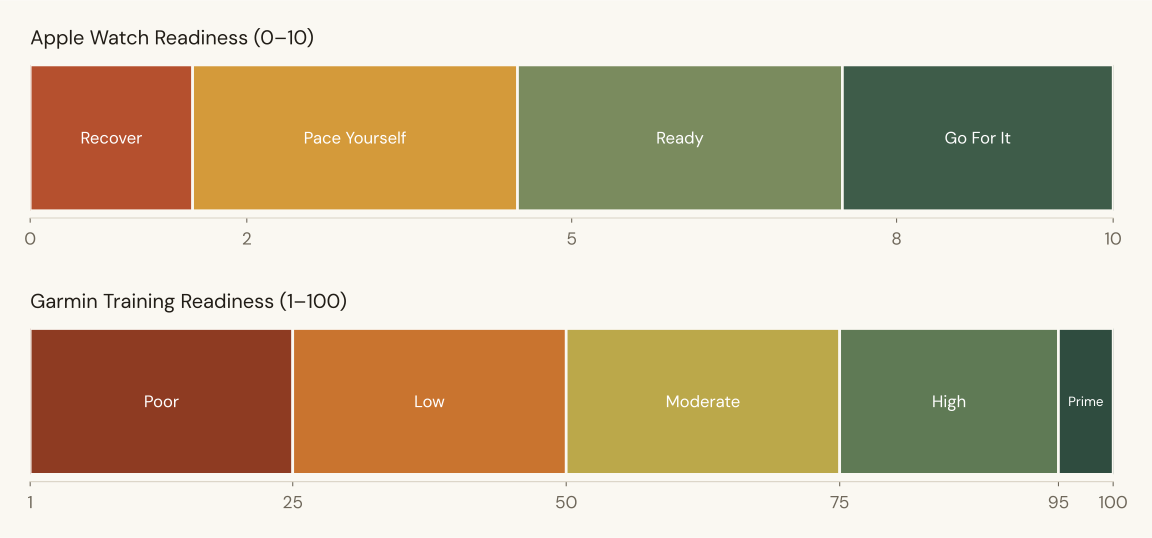
Until September, Garmin owned the readiness score for runners and Apple Watch owners borrowed one from a third-party app. watchOS 27 changed that. If you run with either watch, or are choosing between them, the useful question is not which score is “right” but what each one is actually looking at.
Side by side
| Apple Watch Readiness | Garmin Training Readiness | |
|---|---|---|
| Scale | 0–10 | 1–100 |
| Bands | Recover, Pace Yourself, Ready, Go For It | Poor, Low, Moderate, High, Prime |
| Training inputs | Active calories, workout effort ratings, Training Load | Acute load, recovery time from recent sessions |
| Body inputs | Overnight heart rate, respiratory rate, wrist temperature, HRV, blood oxygen where available; daytime heart rate | HRV status (7-day average against baseline), three days of stress history |
| Sleep | Sleep Score and recent sleep history | Sleep score and three days of sleep history |
| Baseline | At least 7 nights of the past 49 | About three weeks of nightly wear for HRV status |
| Updates | Through the day | Through the day |
| Watches | Series 12, Ultra 4 | Forerunner 70, 170, 265, 570, 955, 965, 970; Fenix, Epix, Enduro series |
| Food, drink, weather | No | No |
Where Apple is stronger
Spotting illness. Wrist temperature and respiratory rate are two of the earliest signals that you are getting sick, and Garmin’s score uses neither. If the question is “am I coming down with something?”, Apple has more evidence to work with.
HRV sampling. Series 12 and Ultra 4 take HRV as often as every five minutes and separate Recovery HRV from Overall HRV. More samples mean a steadier overnight value.
Showing its working. Apple’s factor breakdown tells you which leg moved the score. Garmin shows its six factors too, but the labels are terser.
Where Garmin is stronger
It was built for training. Recovery time comes from the Training Effect of each session, and acute load is judged against what Firstbeat’s model thinks you can absorb. That is a more athletic idea of readiness than calories and effort ratings.
HRV status is a weekly trend. Garmin feeds Readiness a seven-day HRV average against your baseline, which is precisely how Plews and colleagues showed HRV should be read. HRV Status explained has the detail.
Stress history. Three days of daytime stress capture the accumulated load of life outside running, which Apple reads only through daytime heart rate.
Apple is better at noticing you are ill. Garmin is better at noticing you are overcooked. Neither notices you skipped dinner.
Why the numbers can’t be compared
A 7 on Apple is not a 70 on Garmin. The scales are different, the bands are different, and the inputs overlap only partly. The HRV underneath them differs too. Apple Health has always stored HRV as SDNN, the standard deviation of beat-to-beat intervals. Garmin reports an overnight value based on RMSSD, which reflects short-term, parasympathetic variation. Shaffer and Ginsberg’s review of HRV metrics is clear that the two are different quantities with different normal ranges, so an Apple Watch reading of 45 and a Garmin reading of 45 do not mean the same thing. Apple added a native RMSSD type to HealthKit in its 27 releases, but has not confirmed which reading Apple Watch writes to it.
The practical rule: compare each device with itself, never with the other. If you wear both, pick one as your recovery source and stick with it.
What both miss
Fuel
Neither knows you ran 25km on a gel and a banana. Low glycogen is the most common reason a runner feels flat, and it is invisible to both. How to fuel a long run.
Drink
Both see alcohol’s effect on your vitals. Neither can tell you that the effect was alcohol. Alcohol and running.
Weather
A run in heavy air costs heart rate and HRV without much muscular fatigue, and both scores count it as load. Dew point for runners.
Which should you trust?
Neither on a single morning. Both are useful as a trend, both are best read alongside the question of what changed yesterday, and both are weakest exactly when something unusual happened. If you are choosing a watch for recovery tracking alone, Apple’s illness signals and Garmin’s training model are a genuine trade-off rather than a clear win. If you already own one, it is good enough — the gap in your data is not a better score, it is the cause. More on each: Apple Watch Readiness, explained and is Garmin Training Readiness accurate?
Kovr reads both — and adds what neither can see.
Apple Watch HRV, sleep and workouts flow into Kovr automatically through Apple Health. From a Garmin, Kovr reads workouts, sleep and heart rate the same way and takes your HRV in thirty seconds each morning. Then it adds your food, your drinks and the dew point of every run, and tells you in one sentence what actually changed.
Download Kovr on the App StoreFree with a 14-day trial · Apple Watch, Garmin & Oura
Sources cited
- Apple (2026). Introducing Apple Watch Series 12 with the all-new Health Sensing System. Apple Newsroom — Apple Watch Readiness inputs, scale and the Health Sensing System
- Firstbeat Technologies (2014). Stress and Recovery Analysis Method Based on 24-hour Heart Rate Variability (white paper). Firstbeat Technologies Ltd — the HRV-based load, stress and recovery model behind Garmin’s scores
- Plews, D.J., Laursen, P.B., Stanley, J., Kilding, A.E. & Buchheit, M. (2013). Training adaptation and heart rate variability in elite endurance athletes: opening the door to effective monitoring. Sports Medicine — weekly rolling HRV averages against a personal baseline
- Shaffer, F. & Ginsberg, J.P. (2017). An overview of heart rate variability metrics and norms. Frontiers in Public Health — SDNN and RMSSD as different HRV quantities with different norms
- Miller, D.J., Sargent, C. & Roach, G.D. (2022). A validation of six wearable devices for estimating sleep, heart rate and heart rate variability in healthy adults. Sensors — overnight HRV agreement for consumer wearables including Apple Watch and Garmin
Frequently asked questions
Is Apple Watch Readiness better than Garmin Training Readiness?
Neither is simply better. Apple uses wrist temperature, respiratory rate and blood oxygen, which makes it stronger at spotting illness. Garmin uses recovery time, acute load and a seven-day HRV status, which makes it more built around training. Both are useful as trends and weak as single-morning verdicts.
Can I compare my Apple Watch HRV with my Garmin HRV?
No. Apple Health stores HRV as SDNN, while Garmin reports an RMSSD-based overnight value. They are different measures with different normal ranges. Compare each device only with its own history.
Is a 7 on Apple Watch Readiness the same as 70 on Garmin?
No. The scales, bands and inputs are different, so there is no conversion between them.
Do Apple Watch Readiness or Garmin Training Readiness use nutrition or weather?
Neither does. Both see the effect of a hot run, a big night or an under-fuelled week on your heart rate and HRV, but neither knows the cause.
Which Garmin watches have Training Readiness, and which Apple Watches have Readiness?
Garmin: Forerunner 70, 170, 265, 570, 955, 965 and 970, plus Fenix, Epix and Enduro series watches; not the Forerunner 165 or 255. Apple: Series 12 and Ultra 4 only.
Can Kovr read both Apple Watch and Garmin?
Yes. Kovr reads both through Apple Health. Apple Watch HRV arrives automatically; Garmin keeps HRV in its own app, so you add the morning number in about thirty seconds.