Short answer
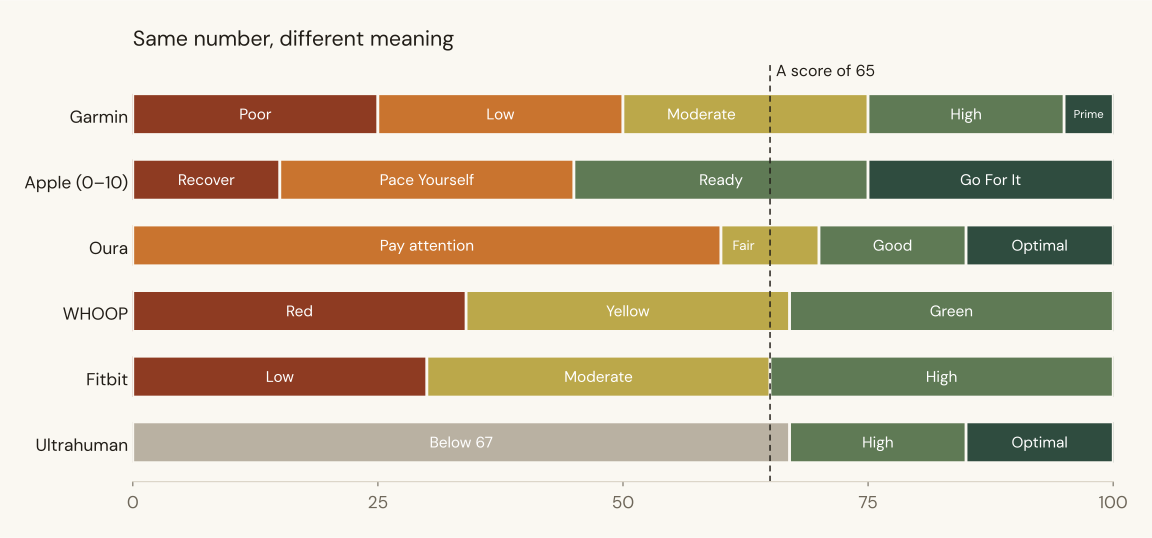
Every major readiness score is built on the same core: overnight HRV against your own baseline, plus sleep. They differ in what else they add and in their scales. Garmin Training Readiness (1–100) adds recovery time and training load, which makes it the most training-aware. Apple Watch Readiness (0–10, Series 12 and Ultra 4 only) adds wrist temperature, respiratory rate and Training Load. Oura Readiness (0–100, nine contributors) and WHOOP Recovery (1–99%) need a paid membership; Garmin, Apple, Samsung’s Energy Score and Ultrahuman’s Recovery Score do not. The bands are not interchangeable: 65 is High on Fitbit and short of Oura’s Fair. And none of them knows what you ate, what you drank or the weather you ran in.
Search for “best readiness score” and you get listicles written before half of these scores existed. This is the current state of play, from the help pages and owner’s manuals of each brand, with a runner’s eye on what each one actually tells you.
The seven scores side by side
| Score | Scale and bands | What goes in | Subscription |
|---|---|---|---|
| Garmin Training Readiness | 1–100: Poor 1–24, Low 25–49, Moderate 50–74, High 75–94, Prime 95–100 | Sleep score, sleep history, recovery time, HRV status, acute load, stress history | No |
| Apple Watch Readiness | 0–10: Recover 0–1, Pace Yourself 2–4, Ready 5–7, Go For It 8–10 | Activity and Training Load; overnight heart rate, respiratory rate, wrist temperature, HRV, blood oxygen; Sleep Score | No (Series 12 and Ultra 4 only) |
| Oura Readiness | 0–100: Optimal 85+, Good 70–84, Fair 60–69, Pay attention below 60 | Nine contributors: resting heart rate, HRV balance, body temperature, recovery index, sleep, sleep balance, sleep regularity, previous day activity, activity balance | Yes, Oura Membership |
| WHOOP Recovery | 1–99%: red 1–33, yellow 34–66, green 67–99 | HRV, resting heart rate, sleep performance, respiratory rate | Yes, WHOOP membership |
| Fitbit Daily Readiness | 1–100: Low 1–29, Moderate 30–64, High 65+ | HRV, recent sleep, resting heart rate | Score in the Google Health app; Premium adds coaching around it |
| Samsung Energy Score | 0–100 | Sleep, daily activity, HRV during sleep | No; needs a Galaxy phone |
| Ultrahuman Recovery Score | 0–100: Optimal above 85, High 67–85 | Sleep Index, resting heart rate, HRV Form, skin temperature, Stress Rhythm Score | No |
Two other rings, RingConn Gen 2 and Amazfit Helio, track overnight HRV, sleep and stress with no subscription. Circular’s rings score energy and other metrics on a 1–100 scale, also without a monthly fee.
What they all share
Strip away the branding and every score above does the same core job: it compares last night’s HRV, and usually resting heart rate, with your own rolling baseline, then weighs in your sleep. That is the right approach. Plews and colleagues showed that individual, rolling HRV comparisons track how athletes are adapting far better than any single reading or population norm. It is also why every score needs a week or more of nights before it means anything: Fitbit asks for seven nights, Apple for seven of the past 49, and Garmin builds its HRV baseline over about three weeks.
The underlying sensors are better than their reputation. Miller and colleagues tested six wearables against laboratory measures overnight and found the better devices tracked heart rate and HRV well during sleep. The composite scores built on top are another matter: the weightings are proprietary, and none has been validated as a training tool in its own right.
Where they differ
Training load
Garmin is the only score that puts recovery time from your last workouts and your acute training load directly into the number, which is why it is the most training-aware. Apple adds Training Load and workout effort ratings. Oura uses previous-day activity and activity balance. WHOOP keeps load out of Recovery and reports it separately as Strain, so you read the two side by side.
Temperature
Apple, Oura and Ultrahuman read skin or wrist temperature; Garmin Training Readiness does not. Temperature and respiratory rate are among the first signals to move when you are getting sick, so these scores tend to catch an oncoming illness that a load-heavy score explains away.
Through the day
Garmin, Apple and Ultrahuman all update after you wake. Garmin’s recovery time counts down and stress accumulates; Apple’s moves with activity, naps and daytime heart rate; Ultrahuman’s Stress Rhythm Score can shift it by up to ten points either way. For training decisions, read the morning number and treat the rest of the day as commentary.
The scales
The same number means different things. A 65 is High on Fitbit, Moderate on Garmin, short of Oura’s Fair band and below Ultrahuman’s High. A 7 on Apple is Ready, not 70% of anything. Never compare two brands’ numbers; compare each with your own normal.
Every score can tell you your body is off. None of them can tell you whether the cause was the run, the wine or the weather.
Rings vs watches for runners
A ring is a recovery device first. None of the mainstream rings has GPS or a screen, so for pace and distance on a run they lean on your phone, and most runners still wear a watch for training. What a ring offers is comfort at night and, often, temperature sensing. Many runners wear both.
If you do, know that the two scores won’t talk to each other. Garmin calculates Training Readiness on the watch from its own sensors, so an Oura, Ultrahuman or Samsung ring doesn’t feed it, and you will get two numbers that sometimes disagree. Pick one as your morning signal and use the other as a cross-check. If you use Apple Health, note that Apple Watch is the device that writes HRV there; most other brands keep it in their own app. What each wearable syncs to Apple Health has the detail.
Which is best for a runner?
You already train with a Garmin
Use Training Readiness. It is the only score that knows your recovery time and load. Training Readiness explained.
You have an Apple Watch Series 12 or Ultra 4
Readiness is free, shows its factors and reads temperature. How it compares with Garmin.
You don’t want to sleep in a watch
A ring. Oura has the deepest app; Ultrahuman, Samsung (with a Galaxy phone) and RingConn have no subscription.
You want the most data and don’t mind paying
WHOOP, worn around the clock, with Recovery and Strain read together.
What none of them see
Every score above reads the effects of your day and none of them reads the causes. An under-fuelled long run, three glasses of wine, a 20°C dew point and a stressful week all look the same overnight: lower HRV, higher resting heart rate, a lower number. Buchheit’s review makes the point that heart-rate measures respond to heat, illness, alcohol and load alike and can’t separate them. That is the gap to fill yourself — by asking what changed yesterday — or with something that records it.
How to use any readiness score
Read the morning value. Open the factors, not just the number. Ask what changed yesterday. One low morning with an obvious cause means train as planned or go a little easier; three low mornings with no cause you can name means back off. And when the score and your legs disagree, remember that no wrist or finger sensor measures muscle damage.
Whichever score you wear, Kovr adds the why.
Apple Watch writes HRV, sleep and workouts to Apple Health, so Kovr reads them automatically. On Garmin or Oura, Kovr asks for the morning number once — thirty seconds, voice or text. Then it reads that number against what you ate, what you drank and the temperature and dew point of every run, so a low morning comes with a cause.
Download Kovr on the App StoreFree with a 14-day trial · Apple Watch, Garmin & Oura
Sources cited
- Garmin (2026). Training Readiness. Garmin owner’s manuals — the six factors and five bands of Training Readiness
- Apple (2026). Introducing Apple Watch Series 12 with the all-new Health Sensing System. Apple Newsroom — Apple Watch Readiness: inputs, the 0–10 scale and four bands
- Oura (2026). Readiness Score. Oura Help — the nine Readiness contributors and score bands
- WHOOP (2026). How does WHOOP Recovery work?. WHOOP Support — Recovery inputs and the red, yellow and green bands
- Google (2026). Daily Readiness. Google Health Help — Daily Readiness inputs, bands and the seven-night baseline
- Ultrahuman (2026). Recovery Score. Ultrahuman Science — the five Recovery Score contributors and the Stress Rhythm adjustment through the day
- Samsung (2024). Galaxy Ring and the Energy Score. Samsung Newsroom — the Energy Score on Galaxy Ring and Galaxy Watch
- Plews, D.J., Laursen, P.B., Stanley, J., Kilding, A.E. & Buchheit, M. (2013). Training adaptation and heart rate variability in elite endurance athletes: opening the door to effective monitoring. Sports Medicine — individual, rolling HRV comparisons track adaptation better than single readings
- Buchheit, M. (2014). Monitoring training status with HR measures: do all roads lead to Rome?. Frontiers in Physiology — heart-rate measures respond to heat, illness, alcohol and load alike
- Miller, D.J., Sargent, C. & Roach, G.D. (2022). A validation of six wearable devices for estimating sleep, heart rate and heart rate variability in healthy adults. Sensors — overnight heart rate and HRV accuracy across six wearables
Frequently asked questions
Which readiness score is most accurate?
None has been validated as a training tool. The overnight heart rate and HRV underneath them are reasonably accurate on the better devices, but each brand weights its inputs differently and keeps the weights private. The most useful score is the one you wear every night and read against your own normal.
Which recovery tracker has no subscription?
Garmin Training Readiness, Apple Watch Readiness, Samsung’s Energy Score on Galaxy Ring and Galaxy Watch (with a Galaxy phone), Ultrahuman Ring Air, RingConn Gen 2, Amazfit Helio and Circular’s rings all work without a monthly fee. Oura and WHOOP require paid memberships.
Does a readiness score update if I take a nap?
It depends on the brand. Apple Watch Readiness updates through the day and moves with naps, activity and daytime heart rate. Garmin Training Readiness also updates as recovery time counts down and stress accumulates. Ultrahuman’s score can move by up to ten points through the day. Use the morning value for training decisions.
Can a daily readiness score tell me whether to push hard or rest?
It is a good prompt, not an instruction. Check which factors are driving the number and what changed yesterday. One low morning with an obvious cause rarely matters; several low mornings with no cause you can name is a reason to back off.
Can I use an Oura ring with Garmin Training Readiness?
Not as an input. Garmin calculates Training Readiness from the watch’s own sensors, so ring data doesn’t feed it. You can wear both, but you will get two separate scores that sometimes disagree.
Do smart rings have GPS?
No mainstream smart ring has built-in GPS. Rings track sleep, HRV, heart rate and temperature well, but for the pace and distance of a run they rely on your phone, so most runners still train with a watch.
Is HRV worth tracking if you’re not an athlete?
Yes, as a trend. Overnight HRV against your own baseline reflects sleep, stress, alcohol and illness as well as exercise. Ignore single readings and population norms; watch for several days in a row outside your usual range.