Short answer
Strained is a Garmin Training Status that means your recovery is not keeping up with your training. Garmin’s own wording: “There is imbalance between your recovery and training load. It is a normal result after a hard training or major event. Your body may be struggling to recover, so you should pay attention to your overall health.” It appears on watches with HRV Status, when your HRV status points to accumulated fatigue. The usual causes are a race or a hard block, an illness coming on, heat, alcohol, short sleep and life stress. Two to three easy days, good sleep and enough food usually clear it, and it lifts as your HRV status returns to Balanced.
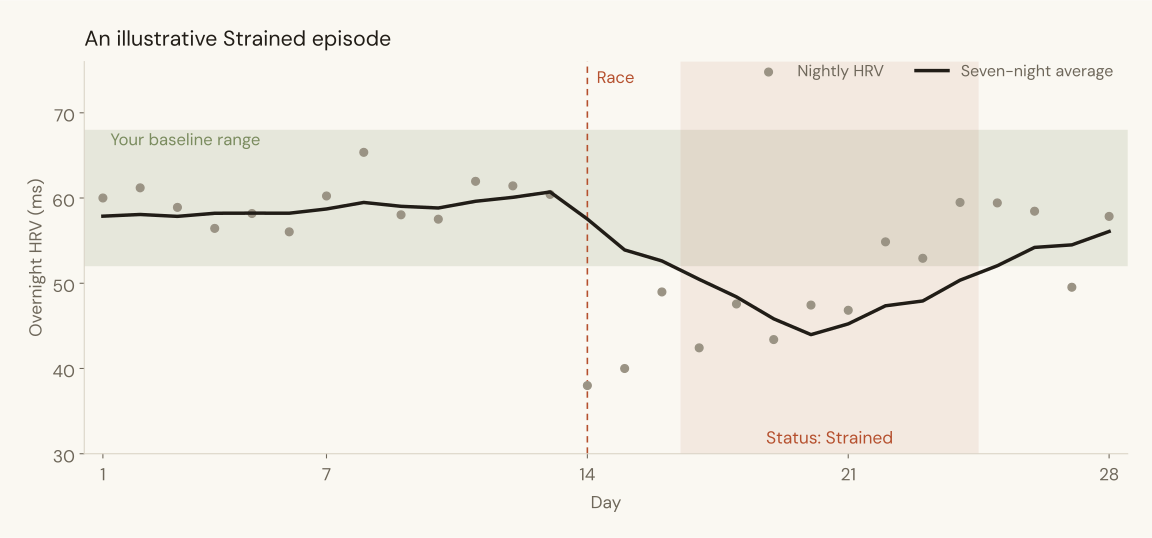
Strained is the Training Status that stops runners in their tracks, partly because it sounds like an injury and partly because it often turns up on a morning when you feel fine. It is neither a diagnosis nor a verdict on your training. It is your watch noticing that your nervous system has not caught up with what you have asked of it.
What does Strained mean on Garmin?
Garmin’s owner’s manuals define it in three sentences: there is an imbalance between your recovery and your training load; it is a normal result after hard training or a major event; and your body may be struggling to recover, so pay attention to your overall health. Garmin’s blog puts it more bluntly: take it easy, you are probably not getting enough recovery time, and this could limit your performance.
The important word is normal. Strained after a marathon, a hard training camp or a big block is the watch doing its job. Strained with no hard training behind it is the version worth investigating.
What triggers it
Training Status reads three things: your VO2 max trend, your acute training load against what you are used to, and, on watches that measure it, your HRV status — your seven-night overnight HRV average against your personal baseline. Strained is the status that leans hardest on that third input. It appears when your HRV status points to accumulated fatigue while your training carries on. Watches without HRV Status can’t show it.
That has two consequences. First, a single bad night rarely causes it, because HRV status is a rolling seven-night average. Second, anything that suppresses overnight HRV for several nights can cause it, whether or not it has anything to do with running.
Strained vs Overreaching vs Unproductive
Three of Garmin’s statuses are warnings, and they point at different problems.
| Status | Garmin’s description | The main signal | What to do |
|---|---|---|---|
| Strained | Imbalance between your recovery and training load; your body may be struggling to recover. | HRV status points to fatigue | Two to three easy days, sleep, food. Check your health. |
| Overreaching | Your training load is very high and counterproductive. Your body needs a rest. | Load far above what you are used to | Cut volume and intensity for several days. |
| Unproductive | Your training load is at a good level, but your fitness is decreasing. | VO2 max estimate falling | Check heat, fuelling, sleep and stress. Seven causes. |
In short, Overreaching is about the training, Unproductive is about the fitness estimate, and Strained is about recovery. You can be Strained on a perfectly sensible training load if something else — a virus, a heatwave, a stressful week — is eating your recovery. For the full set of statuses, see Garmin Training Status explained.
The usual causes
A race or a hard block
The cause Garmin calls normal. After a marathon, expect HRV to sit low for several nights.
An illness coming on
Resting heart rate and HRV often move before you feel unwell. In one smartwatch study, resting heart rate rose ahead of symptoms in most of the COVID-19 cases tracked. Running with a cold covers what to do.
Heat
Hot, humid runs raise heart rate and suppress overnight HRV, and heat also drags down the VO2 max estimate. Why your VO2 max drops in the heat.
Alcohol
Even two drinks can lower overnight HRV and raise resting heart rate. A few evenings in a row is enough to move a seven-night average. Alcohol and running.
Short or broken sleep
Less sleep means less time in the deep sleep where HRV recovers. How much sleep runners need.
Under-fuelling
Running a big week on too few carbohydrates leaves recovery short of raw material. How many carbs runners need.
Life stress and travel
Work deadlines, poor sleep in hotels and time-zone changes all show up in HRV. Your watch can’t tell them apart from training.
Strained tells you recovery is behind. It cannot tell you whether the race, the virus or the wine put it there.
Garmin says Strained but I feel fine
This is common, and it doesn’t mean the watch is wrong. HRV measures your autonomic nervous system, not your legs, and the two recover on different clocks. Your muscles can feel ready while your nervous system is still dealing with a race, a hot week or an infection you haven’t noticed yet.
Ask what changed in the last week. If there is an obvious cause — a race, a run of humid mornings, a few late nights — keep running easy and let it clear. If there is no cause you can name, treat it as an early warning: keep everything easy for a few days and watch for symptoms. If you feel fine and the status clears within days, you have lost nothing.
How long does Strained last?
Usually days, not hours. Because the HRV input is a seven-night average, one good night won’t flip it — you need several in a row to pull the average back into your baseline range. In practice, Strained after a hard week often lifts within three to five easy days; after a marathon, a week or more is normal. If it is still there after a week of easy training and good sleep, or your HRV status is falling towards Low, look beyond training: illness, under-eating or ongoing stress. The signs of overtraining are worth checking against.
What to do when you are Strained
1. Make the next two to three days easy
Easy running or a rest day. Postpone intervals and long runs, don’t cancel the week.
2. Protect sleep
An earlier night does more for HRV than any supplement.
3. Eat enough, especially carbohydrate
Recovery days are not the time to diet.
4. Skip alcohol until it clears
It is the quickest controllable way to lower overnight HRV.
5. Check your health
Sore throat, raised resting heart rate, unusual fatigue: rest, and see a doctor if symptoms are more than mild.
Then keep wearing the watch to sleep. The status needs fresh overnight data to update, and a missing night doesn’t help it clear.
Garmin says Strained. Kovr says why.
HRV stays inside Garmin, so Kovr asks for it once each morning — thirty seconds, voice or text — and reads it against your food, your drinks, your sleep and the weather you ran in. A Strained week becomes “two humid long runs and 90g a day short on carbs” instead of a warning with no cause.
Download Kovr on the App StoreFree with a 14-day trial · Apple Watch, Garmin & Oura
Sources cited
- Garmin (2026). Training Status Levels. Garmin owner’s manuals — Garmin’s definitions of Strained, Overreaching, Unproductive and the other statuses
- Garmin (2026). Garmin Training Status and How to Use It. Garmin Blog — Strained: “Take it easy. You’re probably not getting enough recovery time”; HRV status as an input to Training Status
- Plews, D.J., Laursen, P.B., Stanley, J., Kilding, A.E. & Buchheit, M. (2013). Training adaptation and heart rate variability in elite endurance athletes: opening the door to effective monitoring. Sports Medicine — rolling HRV averages track adaptation and fatigue better than single readings
- Meeusen, R., Duclos, M., Foster, C. et al. (2013). Prevention, diagnosis, and treatment of the overtraining syndrome: joint consensus statement of the European College of Sport Science and the American College of Sports Medicine. Medicine & Science in Sports & Exercise — distinguishing functional overreaching from non-functional overreaching and overtraining
- Mishra, T., Wang, M., Metwally, A.A. et al. (2020). Pre-symptomatic detection of COVID-19 from smartwatch data. Nature Biomedical Engineering — resting heart rate rose before symptom onset in most COVID-19 cases tracked by smartwatch
Frequently asked questions
What does Strained mean on Garmin?
Strained means your recovery is not keeping up with your training load. Garmin describes it as an imbalance between recovery and training load that is normal after hard training or a major event, and says your body may be struggling to recover. It appears on watches with HRV Status when your HRV status points to fatigue.
Is Garmin Strained bad?
Not on its own. After a race or a hard block it is expected. It matters more when there is no hard training behind it, because then something else — illness, heat, alcohol, poor sleep or stress — is suppressing your recovery.
How long does Garmin Strained last?
Usually several days. The HRV input is a seven-night average, so it takes several good nights to move back into your baseline range. Three to five easy days after a hard week is typical; a week or more after a marathon is normal.
Should I run when Garmin says Strained?
Easy running is usually fine if you feel well. Postpone intervals, tempo runs and long runs for two to three days. If you have symptoms of illness, rest.
What is the difference between Strained and Overreaching on Garmin?
Overreaching is about the training: your load is very high and counterproductive. Strained is about recovery: your HRV status points to fatigue, which can happen on a normal training load if illness, heat, alcohol or stress is eating into recovery.
Why does Garmin say Strained when I feel fine?
HRV measures your nervous system, not your muscles, and the two recover at different speeds. Your legs can feel ready while your nervous system is still dealing with a race, heat or an illness you haven’t noticed. If there is an obvious cause, run easy and let it clear.