Short answer
HRV is the variation in timing between consecutive heartbeats, and it reflects autonomic nervous system state — high when recovered, low when carrying stress. There is no target number: a typical rMSSD spans 20–100ms and is highly individual. What matters is your trend against your own rolling baseline, which takes two to four weeks of consistent morning readings to establish.
Your Garmin shows a “Body Battery” of 43 and a yellow face. Your Oura ring gives you a readiness score of 61. Your Apple Watch prompts you to take a Mindfulness session. All three apps are telling you something is off — but none of them tell you why.
Underneath all of those scores is a single metric that drives most of them: heart rate variability, or HRV. If you understand what HRV actually measures, the scores start to make sense — and more importantly, you can use the data to make better training decisions instead of just feeling vaguely anxious about your recovery colour.
What HRV actually measures
Your heart doesn’t beat like a metronome. Even when you’re resting, the time between each beat varies slightly — sometimes a fraction of a millisecond longer, sometimes shorter. This variation is controlled by your autonomic nervous system: the branch that runs unconsciously, governing breathing, digestion, and heart rate.
The autonomic nervous system has two sides. The sympathetic system is your “fight or flight” branch — it speeds things up, narrows the beat-to-beat variation, and prepares the body for action. The parasympathetic system is your “rest and digest” branch — it slows things down, widens the variation, and enables recovery.
The key insight
When your parasympathetic system is dominant — when you’re genuinely recovered — your heart rate variability is high. More variation between beats means the nervous system is flexible, responsive, and ready.
When your sympathetic system is elevated — from training stress, poor sleep, illness, life stress — HRV is low. Less variation means the body is still under load and hasn’t fully recovered.
HRV is measured in milliseconds and reported as rMSSD (root mean square of successive differences) — the most common metric for athletes because it specifically captures parasympathetic activity. Some apps display it as a raw number; others convert it into a score or colour. The underlying measure is the same.
Why it matters more than resting heart rate
Most runners who monitor recovery use resting heart rate as a proxy. It’s easy to measure and it does reflect recovery state — but it’s a late signal. By the time your resting HR rises meaningfully, overtraining has often already taken hold.
HRV changes before resting HR in response to stress and recovery. It’s the earlier warning system. A study published in the British Journal of Sports Medicine found that subjective wellness and HRV both detected training-induced fatigue before objective measures like resting HR showed any change.
That lead time is the whole point. A baseline that drifts down over weeks is the earliest objective sign of overtraining most runners can actually see, and on any single bad morning it is one of four causes worth ruling out.
“HRV doesn’t tell you how fit you are. It tells you how recovered you are — right now, this morning, for today’s session.”
What the research says about HRV-guided training
The most compelling evidence for HRV in running comes from a study on professional runners published in Physiology & Behavior. Runners who trained based on their daily HRV readings showed significant improvements in maximal running speed, while the traditional-training group showed no such improvement. The HRV-guided group also maintained higher moderate-intensity training volume — not because they trained more, but because they trained at the right intensity on the right days.
A separate study from the University of South Bohemia found that adolescent runners using HRV-guided training at altitude improved VO2max by 4.27% compared to 1.26% in the control group — more than three times the adaptation from the same training load, simply by adjusting intensity based on daily readiness.
What the research consistently shows
HRV-guided training doesn’t reduce training volume. It redistributes intensity — harder on ready days, easier on suppressed days. The result is better adaptation from the same total work.
Your personal baseline is everything
The biggest misconception about HRV is that there’s a target number to hit. There isn’t. A typical rMSSD ranges from 20–100ms, but individual variation is enormous. A well-trained 55-year-old with a rMSSD of 28ms might be in excellent shape; a 25-year-old with a rMSSD of 28ms might be overtrained.
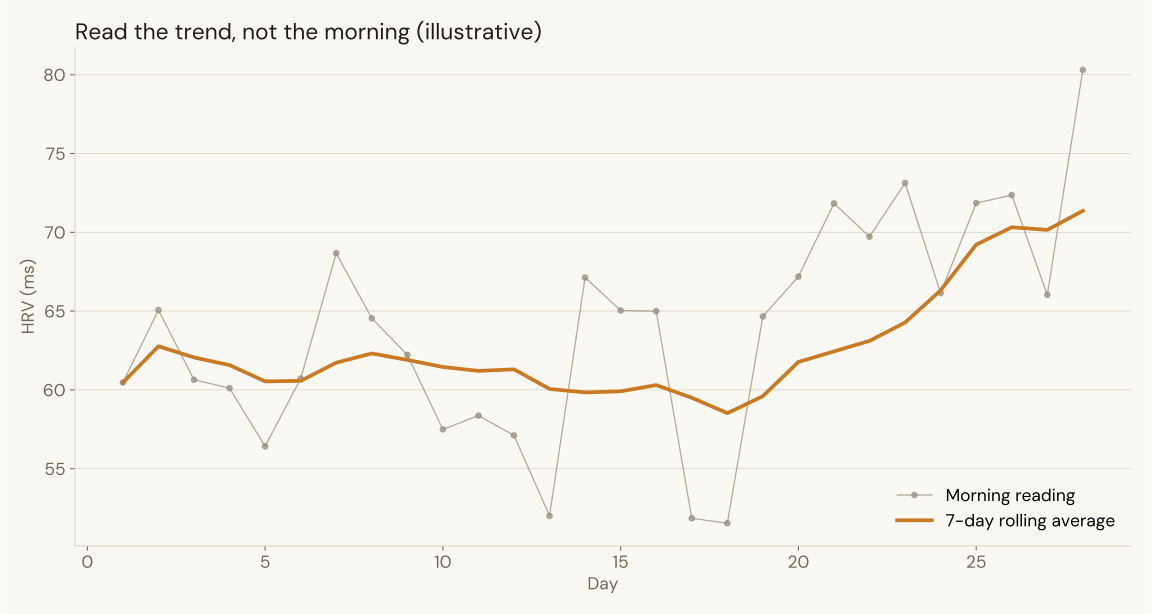
What matters is your trend relative to your own rolling baseline. A 20% drop from your baseline is a meaningful signal regardless of whether your absolute number is 35ms or 75ms. Five years of daily HRV data from one committed athlete found that daily variability (coefficient of variation ~25–29%) dwarfs any long-term trend — meaning day-to-day comparisons are noisy, but comparisons against a 7–14 day rolling average are highly informative.
This is why the first two to four weeks of tracking are primarily about establishing your baseline. Don’t make major training decisions based on early readings. Let the pattern form first.
How to measure HRV properly
Measurement method matters a lot. The same person can get wildly different HRV readings depending on when and how they measure. These rules apply regardless of which device you use:
- Morning, immediately after waking — before you get out of bed, before coffee, before looking at your phone
- Lying down — sitting or standing introduces positional effects that reduce reliability
- Same time every day — even small timing variations add noise
- Consistent recording duration — 60 seconds is the minimum for a reliable short-term reading
Devices that measure overnight HRV (Oura Ring, some Apple Watch models) average across the full sleep period, which is more reliable than a single morning reading. But a consistent morning measurement is far more valuable than an inconsistent overnight one.
Device choice constrains all of this, because not every watch writes HRV anywhere an app can read it — here is what each wearable actually syncs to Apple Health.
Garmin, Apple Watch, and Oura — what each gives you
The three most common devices among serious runners each handle HRV differently:
| Device | HRV method | Shares to HealthKit? | What to do |
|---|---|---|---|
| Garmin | Overnight HRV Status | No — internal only | Read number off watch each morning, log by voice |
| Apple Watch | Background + Breathe app rMSSD | Yes — automatic | Nothing required — reads automatically |
| Oura Ring | Full overnight rMSSD, 99% ECG concordance | Yes — automatic | Nothing required — reads automatically |
Garmin users: the 30-second logging habit is the unlock. Glance at your HRV Status on your watch face, say “HRV 68” into your coaching app while you make your morning coffee. Done. The coaching engine has everything it needs.
What to do with the number
A simple three-zone framework for daily decisions:
- Within 10% of baseline: Train as planned. Normal variation, no adjustment needed.
- 10–30% below baseline: Keep the session easy. No intervals, no tempo. Easy aerobic only, and keep it short if you want to.
- 30%+ below baseline: Rest day or very short easy movement only. Something meaningful is happening — training, illness, life stress, or sleep debt. Don’t override it.
The mistake most runners make is using HRV as a source of anxiety rather than a source of information. A low reading isn’t failure. It’s the body asking for something. The right response is adaptation, not guilt.
Kovr uses your HRV to coach you — not just show you a number.
Garmin, Apple Watch, or Oura Ring: Kovr reads your HRV from whichever source you have, builds your personal baseline, and uses it to explain every session. When the run felt hard, Kovr tells you whether HRV was the reason. When you’re ready to push, Kovr sees that too.
Download Kovr on the App StoreFree with a 14-day trial · Garmin, Apple Watch & Oura
How long before HRV data becomes useful?
Two to four weeks of consistent morning readings establishes a usable baseline. Four to eight weeks produces a reliable baseline with enough data to detect meaningful patterns — alcohol effects, training load responses, sleep sensitivity. Twelve weeks and beyond is where the real insights emerge: correlations between your best performances and the conditions that preceded them.
The athletes who get the most from HRV tracking are the ones who treat the first month as setup, not signal. Collect the data. Let the baseline form. Then use it.
Frequently asked questions
What is HRV for runners?
HRV measures the variation in time between consecutive heartbeats. For runners it reflects how well the autonomic nervous system has recovered from training, sleep, and life stress. Higher HRV means better recovery. Lower HRV means the body is still processing stress.
What is a good HRV for a runner?
There is no universal ‘good’ HRV. A typical rMSSD ranges from 20–100ms, but individual variation is enormous. What matters is your trend relative to your own rolling baseline — a 20% drop signals poor recovery regardless of your absolute number.
How do Garmin runners track HRV?
Garmin tracks HRV internally but doesn’t share it with third-party apps. The simplest approach: read the number off your watch face each morning and log it into your coaching app by voice. Thirty seconds. The coaching engine uses it to contextualise your session.
Should I train when my HRV is low?
A single low reading doesn’t mean skip training. If HRV is 10–20% below baseline, train easy. If it’s 30%+ below baseline for two or more consecutive days, take a genuine rest day. Trend matters more than a single number.
Does Oura Ring measure HRV accurately?
Yes — Oura Gen 4 measures nocturnal HRV with 99% concordance with medical-grade ECG. It writes HRV and sleep data directly to Apple HealthKit automatically.